
The European response
Control over satellite infrastructure has become a major sovereignty and strategic-autonomy issue for Europe. Low Earth orbit constellations now play an essential role in telecommunications, navigation, Earth observation, crisis management and military operations.
The Ukrainian experience, with the decisive role played by Starlink, has shown that a commercial constellation can become critical infrastructure for a State, while remaining under the control of a private foreign company.
For the European Union, lasting dependence on non-European players for communications of such strategic importance would therefore create a technological, economic and geopolitical vulnerability.
Europe must therefore have sovereign, secure and resilient satellite capabilities, while maintaining an industry able to design, build, launch and operate this infrastructure.
This strategy relies in particular on three major programmes:
- Galileo for navigation;
- Copernicus for Earth observation;
- and now IRIS² for secure satellite communications.
The aim is not to cut Europe off from foreign constellations, but to ensure that in the event of a crisis, conflict or failure of terrestrial and submarine networks, Europe retains control of the communication capabilities essential to its States, institutions, armed forces, emergency services and critical infrastructure.
1. Galileo — navigation under a European flag
2. Copernicus — Europe's eyes on the Earth
Europe's satellite positioning system — the most accurate civilian GNSS in the world — is the cornerstone of the EU's space sovereignty.
The European alternative to the American GPS, the Russian GLONASS and the Chinese BeiDou, Galileo is the only global navigation system under civilian control. Funded by the European Commission, developed by ESA and operated by EUSPA (Prague), it has provided an open service since 2016, used by more than five billion smartphones, along with an encrypted Public Regulated Service (PRS) for governments and armed forces.
Two world firsts reinforce its singularity:
- the free High Accuracy Service (HAS, decimetre-level corrections, 2023);
- signal authentication against spoofing (OSNMA, 2025).
Satellite positioning, navigation and timing are vital functions for critical infrastructure — energy, telecoms, finance, transport — which makes Galileo a link in the resilience chain, just like submarine cables.
Europe's Earth-observation programme — the world's largest provider of free and open space data.
The "eyes on the planet" component of the EU space programme, alongside Galileo, Copernicus relies on the Sentinel satellite family:
- Sentinel-1: all-weather radar;
- Sentinel-2: high-resolution optical imagery;
- Sentinel-3: oceans and land surfaces;
- Sentinel-5P: atmospheric composition;
- Sentinel-6: sea-level altimetry.
Its six services cover the atmosphere, the marine environment, land, climate change, emergency management and security.
It is also a tool of sovereignty and maritime surveillance: Sentinel-1's radar, combined with its on-board AIS receiver, can detect ships that are not transmitting — pollution, illegal fishing, shadow fleets — in direct connection with the protection of submarine infrastructure.
3. Ariane 6 — Access to space cannot be outsourced
Approved by ESA member states in 2014 and developed by ArianeGroup with CNES, Ariane 6 is the successor to Ariane 5: a heavy-lift launcher in two versions — 62 with two boosters, 64 with four — able to place around twenty tonnes into low Earth orbit from Kourou, with a restartable upper stage that can drop a constellation's satellites into several orbits in a single flight. Its development cost around four billion euros and ran four years late: the maiden flight, planned for 2020, did not take place until 9 July 2024 — and it was this delay, combined with Vega-C's setbacks and the departure of Soyuz, that triggered the 2023 "launcher crisis" and the humiliation of entrusting the Galileo satellites to Falcon 9.
Since then, the launcher has been doing what it was built for. In March 2025 it launched the CSO-3 military observation satellite — a payload France would have entrusted to no one else —, it is ramping up towards some ten flights a year, and its order book mixes institutional missions (Galileo, IRIS², meteorology, defence) with commercial customers, first among them… Amazon, which has booked 18 launches for its Kuiper constellation. The irony is only apparent: Europe's guaranteed access to space is also being paid for by other people's customers.
Because that is what this is really about: Ariane 6 is not a commercial product, it is an insurance policy. Its economic model accepts a premium over SpaceX — the launcher is not reusable, and its flight rate will remain far below Falcon 9's hundred-plus flights a year — in exchange for a guarantee: whatever happens, Europe can put its navigation, observation, defence and, soon, communication satellites into orbit, from its own territory, with its own technology. It is the same reasoning as for the cable-ship fleet or the sovereign cloud: you do not compare the price of a service with that of a capability you are certain to keep.
- The launch rate: the challenge of the coming years is industrial — sustaining some ten flights a year to work through the Kuiper, Galileo and IRIS² order book, where Ariane 5 managed five or six;
- Reusability: the reusable Prometheus engine and the Themis demonstrator are preparing what comes next, and MaiaSpace, an ArianeGroup subsidiary, is developing a partially reusable mini-launcher;
- The next generation: ESA's European Launcher Challenge opens institutional contracts to young private launcher companies for the first time — Isar Aerospace, Rocket Factory Augsburg, Latitude (Reims), PLD Space — to bring about European competition;
- The light complement: Vega-C, back in flight since late 2024, covers small payloads from Kourou.
What is at stake. Ariane 6 gives Europe back its access to space; it does not yet give it the means for the age of constellations. Deploying and renewing IRIS² or a future observation constellation will demand a flight rate and costs that only reusability can deliver — the bet is that the Prometheus-Themis generation and the new entrants get there before the delay turns back into a dependence. Until then, every Ariane 6 launch from Kourou is a sentence of sovereignty written across the sky.
4. Eutelsat OneWeb — the European constellation in low Earth orbit
The only operational Internet constellation in low Earth orbit apart from Starlink — and the sector's only European operator.
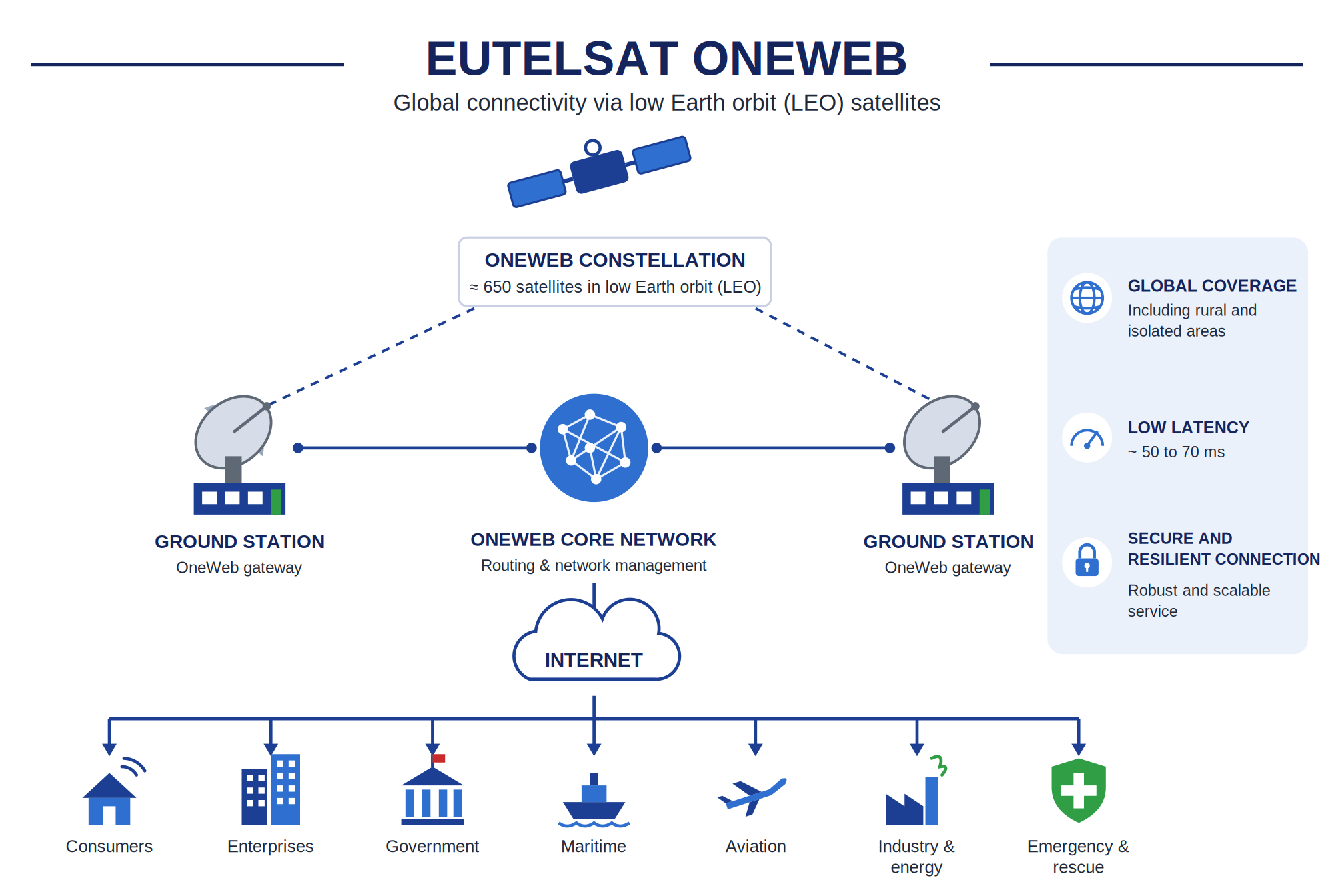
Born from the merger of Eutelsat and OneWeb in 2023 — creating the world's first integrated GEO-LEO operator — the constellation numbers more than 600 satellites across 12 orbital planes at an altitude of 1,200 km, providing low-latency global coverage.
Unlike Starlink, it targets the professional market exclusively: enterprises, maritime, aviation and, above all, sovereign connectivity for governments. The French Ministry of the Armed Forces has secured access to it while awaiting IRIS², for which Eutelsat is the industrial lead (SpaceRISE consortium). The French State is the group's largest shareholder (~30% of the capital since 2025).
440 new-generation satellites have been ordered from Airbus, built in Toulouse, for deliveries starting in late 2026.
5. The IRIS² project — the Union's sovereign constellation
A satellite infrastructure for resilience, interconnection and security — the EU's third flagship space programme, after Galileo and Copernicus.
Launched in response to Europe's dependence on Starlink, IRIS² will provide secure and resilient connectivity to EU governments, armed forces and emergency services — encrypted communications, protection of critical infrastructure, crisis management — with a commercial component to follow.
The programme is backed by a public-private partnership worth around €11 billion: a 12-year concession signed in December 2024 with the SpaceRISE consortium (Eutelsat, SES, Hispasat), supported by ESA.
The implementation agreement signed on 7 August 2026 moved the project from planning to industrial deployment, strengthening the constellation with 66 additional satellites to meet coverage needs and jamming resistance requirements.